
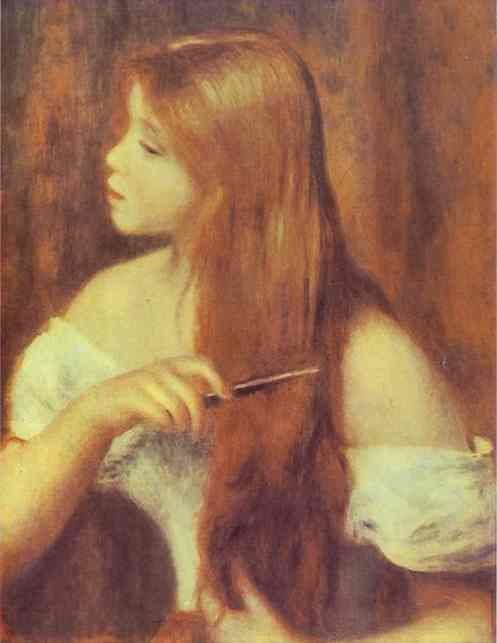
Pierre-Auguste Renoir, Young Girl Combing Her Hair (Jeune fille coiffant ses cheveux), 1894. This painting perfectly mirrors the ethereal, quiet beauty of Claude Debussy’s The Girl with the Flaxen Hair (La fille aux cheveux de lin).
Composed in an intense burst of creative energy between late 1909 and January 1910 at his home in Paris, Claude Debussy’s La fille aux cheveux de lin entered the cultural landscape as an invisible canvas before its official publication in April 1910 and its public premiere that June. Featured within his landmark first book of Préludes, this brief, mesmerizing piano masterpiece manages to collapse the boundaries between French literature, impressionist painting, and modern soundscapes. Inspired by a pastoral poem of rustic Scottish innocence, Debussy took a timeless visual motif — the golden-haired girl as a symbol of Unblemished innocence – and translated it into uncompromising, floating chords. In doing so, he did not just compose a melody; he revolutionized the 20th-century music world by proving that a composer could paint directly onto the air.
To understand the luminous landscape Debussy creates, one must first look to the written word. The title, La fille aux cheveux de lin, was lifted directly from an 1852 poem by Charles-Marie-René Leconte de Lisle, a key figure in the French Parnassian literary movement. While the romantic composers who preceded Debussy chased intense, turbulent emotions, the Parnassians believed in “art for art’s sake”- valuing objective, formal beauty and emotional restraint. Debussy shared this philosophy deeply.
In de Lisle’s poem, a golden-haired girl sits in the morning sun, singing a naive song of love amidst fields of blooming lucerne. Debussy does not merely illustrate this scene; he translates its literary texture into sound. The piece opens with a solitary, unaccompanied melody that floats across the keys. By transcending the heavy, dramatic chord progressions typical of the 19th century, Debussy captures the literal “breath of the morning air”, transforming a poetic vignette into a living sonic atmosphere.
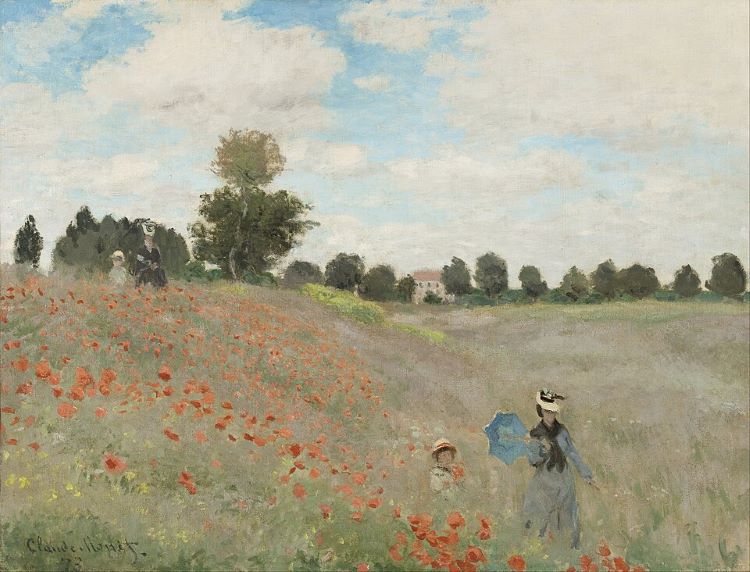
Monet’s vibrant landscape captures the fleeting, atmospheric warmth found in auditory watercolor.
Painting with Chords:
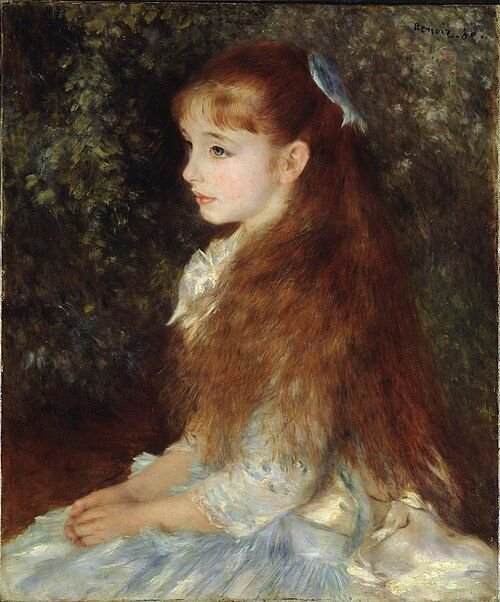
While Debussy famously resisted the term “Impressionism” when applied to his music, the visual parallels in The Girl with the Flaxen Hair are undeniable. In the world of fine art, a young girl with cascading, pale golden hair was a powerful iconographic symbol of absolute purity, untouched innocence, and quiet solitude. One can easily look at Pierre-Auguste Renoir’s 1880 portrait, Little Irene, and see the exact visual manifestation of Debussy’s subject: a serene girl bathed in soft, natural light, entirely detached from the chaos of the modern world. Debussy achieves this exact visual warmth through his revolutionary musical style, essentially using the piano keyboard as a painter’s palette. Instead of building tension and releasing it through traditional classical harmonies, he employs parallel chord structures. He moves solid blocks of chords up and down the piano in unbroken lines. To the listener, this mimics the exact technique of an Impressionist painter placing unblended strokes of pure color side-by-side on a canvas. The chords exist not to progress toward a destination, but simply to radiate color and texture in the present moment.
The Power of Silence and Simplicity:
The true impact of The Girl with the Flaxen Hair (La fille aux cheveux de lin), on the broader musical world lies in its understated eloquence and “quiet grace”. Published in 1910, the prelude arrived at a moment when European music was becoming increasingly dense, complex, and dissonant. Composers were competing to write the loudest symphonies and the most dizzying, virtuosic piano solos. Debussy did the exact opposite. He stunned the musical establishment by retreating into absolute simplicity. The piece relies heavily on the pentatonic scale – a five-note scale that completely eliminates harsh intervals or tonal friction. Furthermore, Debussy’s entire dynamic range for the composition is quiet, stretching only from a whisper to a gentle, glowing hum. Even the song’s climax is an exercise in profound emotional restraint. By proving that a piece of music could completely transfix an audience through quietude, Debussy provided a blueprint for 20th-century modernism. His spatial, atmospheric style went on to deeply influence the fluid harmonies of modern jazz and laid the groundwork for the evocative, visual world of cinematic film scoring.
The Secret Hidden below the Composition:
In a final touch of artistic brilliance, Debussy hid the prelude’s title at the bottom of the last page. He wanted audiences to experience the abstract sound unburdened by expectations. Over a century later, The Girl with the Flaxen Hair remains a monumental achievement – a timeless portrait that teaches us to listen with our eyes and see with our ears.
About the Composer: Born in Saint-Germain-en-Laye, France, Claude Debussy (1862–1918) entered the Paris Conservatoire at the age of just ten. He grew into one of the most influential composers of the modern era. By blending non-traditional scales with fluid chord structures, Debussy successfully bridged the gap between fine art and sound literature, forever changing how the world listens to classical piano music. His iconic works – including Clair de lune, La Mer, and his two books of Préludes – remain timeless pillars of modern impressionism, with ‘The Girl with the Flaxen Hair’ standing out as a masterpiece of delicate simplicity.

Created: 1890-1910
#Debussy #ClaudeDebussy #LaFilleAuxCheveuxDeLin #TheGirlWithTheFlaxenHair #ClassicalMusic #PianoPreludes #ImpressionistArt #ArtHistory #Portrait #VideosoundArtMagazine